Updated October 2026
Quick answer
An industrial electrician in Oklahoma City installs and repairs the power and controls behind production equipment: motors and variable frequency drives, machine and conveyor wiring, three-phase feeders, panelboards and motor control, and the troubleshooting that gets a stopped line running again. Work is planned around shutdowns, done under lockout and tagout, and permitted where the city requires it.
Plants, shops and production lines
What industrial electrical work involves
Industrial work is less about outlets and lights and more about motors, controls and the power that feeds them. A typical call is a conveyor motor that trips on start, a new compressor or CNC machine that needs a circuit, a drive that faults under load, or a shop that has outgrown its distribution panel. Each of those involves three-phase power, motor protection sized to the nameplate, and controls that have to work with the equipment manufacturer's requirements.
We work to the motor and industrial machinery articles of the National Electrical Code, follow lockout and tagout on every circuit we open, and plan the work around your production schedule. Small jobs are done during a shift change; larger ones, like a new feeder or a panel replacement, are scheduled for a planned shutdown with the materials staged in advance so the outage is as short as possible.
Choosing between the options
Starters, soft starters or drives
| Approach | Best for | Trade-off |
|---|---|---|
| Across-the-line starter | Fixed-speed loads that start rarely | Hard starts, no speed control |
| Soft starter | Large pumps and fans that need gentle starts | No speed control while running |
| Variable frequency drive | Fans, pumps and conveyors that vary in speed | Higher cost, needs drive-rated wiring |
| Motor replacement only | Failed motors in a sound system | Leaves old controls in place |
What moves the price
What decides the cost of industrial work
- Scope of the job A single motor swap versus a new feeder and panel.
- Voltage and phase 480V and 208V three-phase work needs different gear.
- Equipment lead times Drives, transformers and switchgear vary in availability.
- Shutdown scheduling Night and weekend work costs more than daytime.
- Access Lifts, heights and crowded equipment rooms add time.
- Testing and documentation Insulation tests, infrared scans and labeling.
- Permits New feeders and equipment circuits are permitted.
Industrial work is quoted from a site visit and the equipment data. National 2026 figures put electrician labor at about $75 to $150 per hour; equipment such as drives and transformers is quoted separately.
What is included
What every industrial job includes
- Equipment nameplates and manuals reviewed
- Circuits sized to the motor or machine data
- Disconnects within sight of the equipment
- Lockout and tagout on every circuit opened
- Rotation and voltage checked before production
- Infrared or torque check on new connections
- Labels and panel schedules updated
Sub-jobs this page covers
Motors, machines, distribution and repairs
Motor and VFD installation
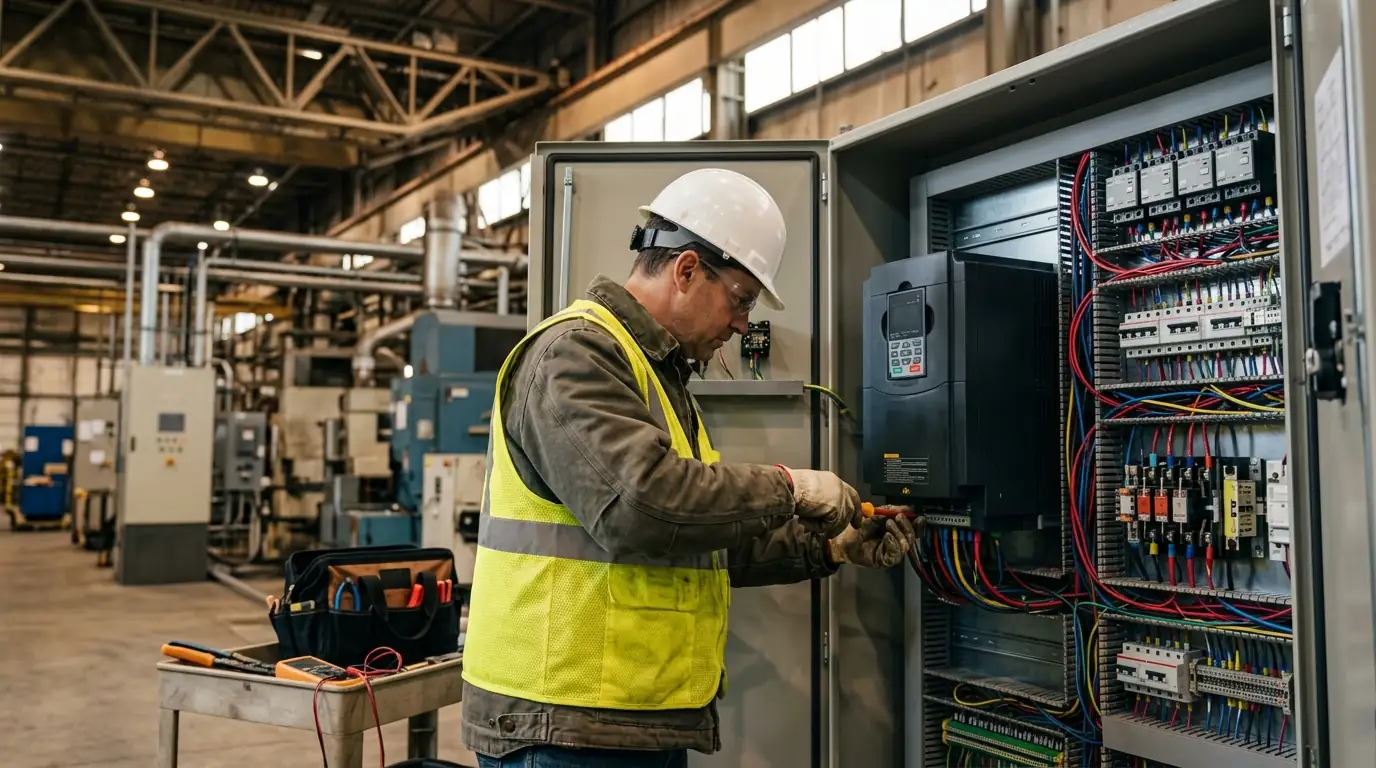
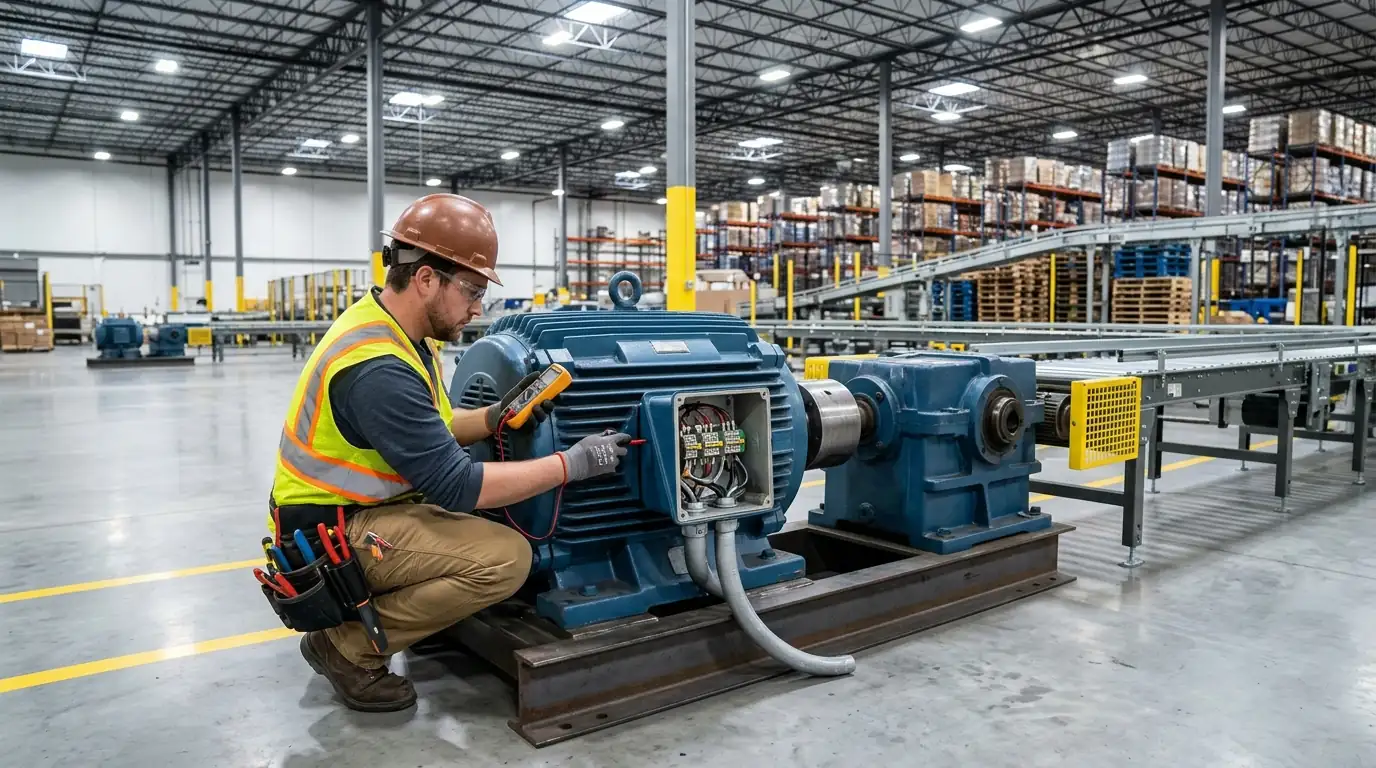
We install and replace three-phase motors and the variable frequency drives that control them, from fans and pumps to conveyors and mixers. That includes sizing the branch circuit, overload protection and disconnect to the motor nameplate, mounting the drive where it can shed heat, and running the motor leads with cable suited to drive output. Drives are programmed for acceleration, deceleration and the motor data, then tested under load. When a drive replaces an across-the-line starter, we also check whether the existing wiring and the motor itself are suitable for drive duty.
Machine and equipment wiring
New machines arrive with a nameplate and a manual, not a power supply. We wire CNC machines, compressors, welders, presses, ovens and packaging lines: the feeder or branch circuit, the disconnect within sight of the machine, grounding, and the connection to the machine's own control panel. Where a machine needs a voltage the building does not have, we install the transformer. Before the machine is energized we check rotation, voltage at the terminals and the equipment ground, and we leave the circuit labeled at both ends.
Three-phase power distribution
As a plant adds equipment, the distribution has to keep up. We install and replace panelboards, feeders, busway drops, transformers and disconnects, and add capacity where the existing service has room. A load study comes first, from the panel schedules, metered readings and the nameplates of the equipment you plan to add, so the new distribution is sized for where the operation is heading rather than where it is today. Any work that needs the utility to disconnect the service is coordinated with them and scheduled outside production hours.
Industrial troubleshooting and repair
When something stops, the goal is to find the actual fault quickly. We work from the symptom: a motor that trips on start, a drive fault code, a control circuit that drops out, a feeder breaker that runs hot. Insulation resistance testing on motors and cable, voltage and current readings under load, and infrared scans of connections narrow it down. We repair what failed, explain why it failed, and point out anything else that is close to the same condition before it becomes the next breakdown.
Oklahoma City conditions
Industry around Oklahoma City
Industrial work in the metro clusters around Tinker Air Force Base and the corridors along Interstate 40 and Interstate 35. Next to Del City, the Tinker Air Logistics Center is described as the world's largest jet engine facility, and the suppliers, machine shops and manufacturers around it run on three-phase power, motors and controls. We serve those plants and shops along with warehouses, food processors and fabrication shops across Oklahoma City, planning each job around the customer's production schedule.
How long it takes
How long industrial jobs take
A motor or drive swap is usually done within a shift, often during a changeover.
Wiring a new machine typically takes one to three days, depending on the run and whether a transformer is needed.
New feeders, panelboards or distribution are planned for a shutdown window, with materials staged beforehand.
Step by step
From site walk to restart
- Site walk
Equipment, panels and the production schedule reviewed.
- Load study and plan
Circuits sized to nameplates; materials ordered.
- Shutdown scheduled
Work set for the window with the least lost production.
- Install under lockout
Circuits locked out, work done, connections torqued.
- Test and hand back
Rotation, voltage and load tested; labels updated.
Questions we get about this job
Industrial electrician questions
Yes, along with 208V and 240V three-phase systems.
Often, after checking that the motor and its wiring are suitable for drive duty.
Yes. Larger jobs are scheduled for nights, weekends or planned shutdowns.
Yes, on every circuit we work on.
Yes, from the manufacturer's electrical data, so it can be connected on delivery.
Yes, along with motor, control and feeder faults.
New feeders, panels and equipment circuits generally do; we handle the filing.
Same category
More panels and power work
Grounding & Bonding Repair
Ground rod and electrode system and more.
GroundingElectric Heater Installation
Baseboard and wall heaters and more.
About Electric Heater InstallationDedicated Circuit Installation
Range and dryer 240V outlets and more.
Dedicated Circuit Installation detailsElectrical Panel Upgrade
100 to 200 amp upgrade and more.
See Electrical Panel UpgradeLine down or new equipment coming?
Call any hour. We get stopped equipment running again and plan new installs around your production.