Updated October 2026
Quick answer
Parking lot lighting repair in Oklahoma City means finding why pole lights are out, cycling or staying on all day, then fixing the cause: failed LED drivers or ballasts, photocells and timers, lighting contactors, breakers, or faults in the underground feeders between poles. We also repair and replace poles knocked down by vehicles or storms and check the pole bases and hand holes. A night check confirms every fixture works after dark.
Dark lots, fixed at the cause
What parking lot lighting repair involves
Lot lighting fails in patterns, and the pattern points to the cause. One dark pole usually means its own fixture: a failed LED driver, an old ballast or lamp, or a loose connection in the pole hand hole. A whole row out points to the circuit: a tripped breaker, a failed contactor, or a fault in the underground wire feeding that row. Lights that stay on in daylight or turn off too early point to the photocell or timer controlling them.
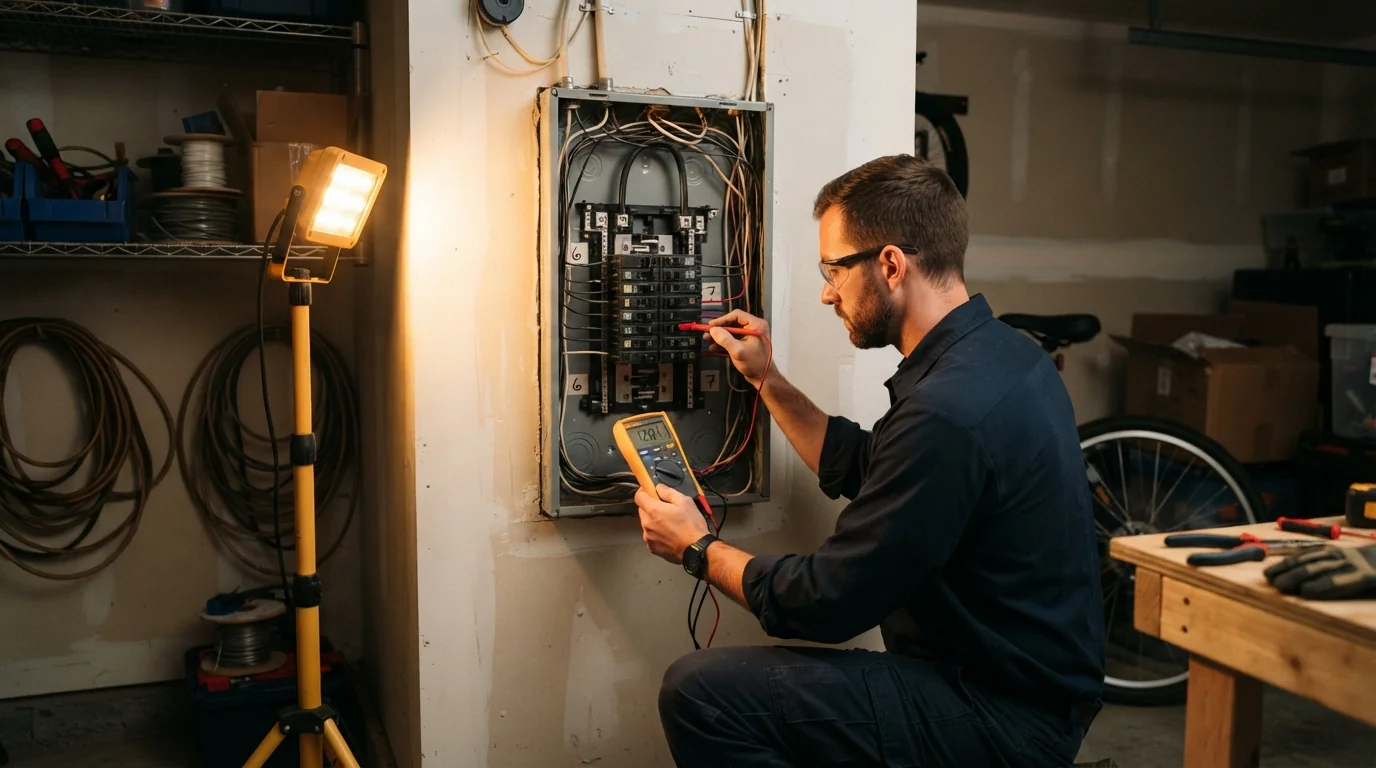
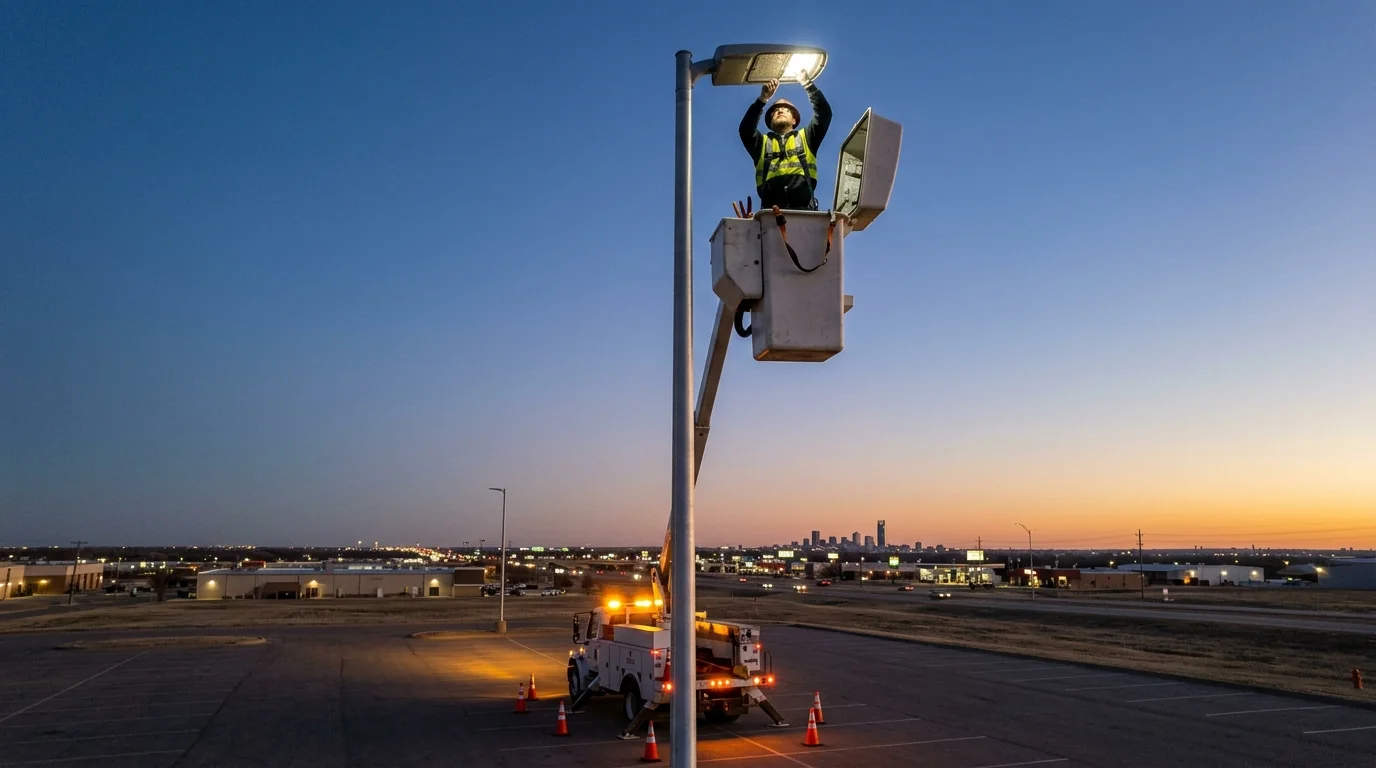
We start at the control point, the panel, contactor and photocell or timer, then work out along the circuit to the poles. Underground faults are found by testing the feeders and locating the break rather than trenching blindly. Fixtures are serviced from a lift sized to the pole height, and when the heads are old enough that repairs are throwing good money after bad, we price an LED replacement alongside the repair so the owner can choose.
Choosing between the options
Repair, retrofit or replace
| Approach | Best for | Trade-off |
|---|---|---|
| Repair the existing heads | Newer fixtures with one failed part | Older heads may keep failing |
| LED retrofit kits in old heads | Sound housings with old lamps | Mixed light if done partly |
| Full LED fixture replacement | Old metal halide or sodium heads | Higher upfront cost, lower upkeep |
| Scheduled maintenance | Owners who want the lot always lit | Ongoing cost |
What moves the price
What decides the cost of a lot lighting repair
- Cause of the outage A photocell costs far less than a feeder repair.
- Number of poles Several heads at once share the lift time.
- Pole height Taller poles need a larger lift.
- Fixture age Old heads may cost less to replace with LED.
- Underground repairs Locating, excavating and patching pavement.
- Pole replacement New pole, base work and arm.
- After-hours work Night checks and repairs outside business hours.
Lot lighting repairs are quoted after testing the circuit. National 2026 figures put electrician labor at about $75 to $150 per hour; lift time, fixtures and any underground work are priced with the repair.
What is included
What a lot lighting repair includes
- Night check of every pole and wall pack
- Panel, breaker and contactor tested
- Photocell and timer settings confirmed
- Underground feeders tested
- Pole bases, bolts and hand holes inspected
- Repairs made and fixtures noted by circuit
- Verified after dark before the job closes
Sub-jobs this page covers
Fixtures, controls, feeders and poles
Pole lights out or cycling
A single pole that is dark, flickering or cycling on and off is usually a fixture problem: an LED driver at the end of its life, an older metal halide or high-pressure sodium lamp and ballast failing, a bad fixture photocell, or water in the head. We test at the pole base first to confirm power is reaching the fixture, then repair or replace the driver, ballast, lamp or head. Where several heads on the same lot are the same age, we tell you which others are likely to go next.
Photocells, timers and contactors
Most lots are switched by a photocell, a timer or both, through a lighting contactor in an electrical room or an outdoor panel. A failed photocell keeps the lights on all day or off all night; a timer that lost power or was set wrong turns them off too early; a contactor with burned contacts drops whole circuits at once. We test each part of the control, replace what failed, and set the schedule so the lot is lit when people are actually there.
Underground feeder faults
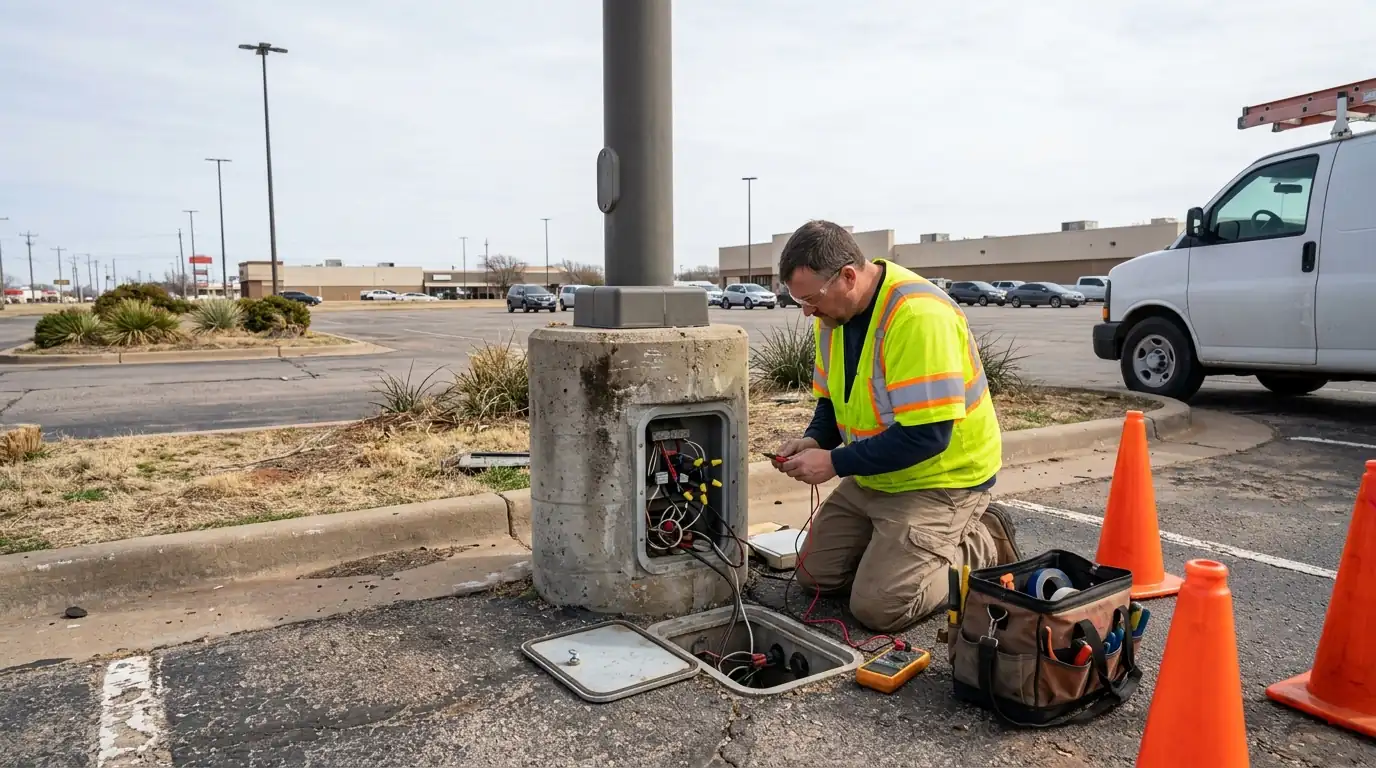
The wire between poles runs underground, where it can be nicked by landscaping, crushed by pavement work or damaged by water at a pole base. A fault there trips the breaker or kills every pole past the damage. We isolate the circuit, test the conductors and locate the fault so the repair is a small excavation at the right spot instead of a trench across the lot. Where the conduit itself has failed, we price a new run, often bored under the pavement.
Knocked-down and leaning poles
Vehicles and storms take down or bend light poles. We make the pole and its wiring safe, disconnect the circuit, and replace the pole, arm and fixture, or reset a leaning pole on a sound base. Pole bases are checked for cracked concrete, corroded anchor bolts and water in the hand hole, the common reasons a pole leans before it falls. Damaged poles are photographed and documented for the insurance claim, and the circuit is restored to the rest of the lot the same day where it is safe to do so.
Oklahoma City conditions
Wind and storms in Oklahoma City
Oklahoma City is one of the windiest major cities in the country, averaging a sustained wind of about 12.8 miles per hour in the long-term climate normals, and spring storms bring far stronger gusts on top of that. Wind loads every pole and fixture head on a lot day after day, working anchor bolts loose, cracking pole bases and shaking connections in the heads. That is why we check the base and the bolts on every pole we work on, not only the light.
Step by step
From night check to a lit lot
- Night check or report
Which poles are out and how they behave.
- Test the controls
Panel, contactor, photocell and timer checked.
- Trace the circuit
Feeders tested and faults located.
- Repair or replace
Drivers, fixtures, wiring or poles fixed.
- Verify after dark
Every fixture confirmed working at night.
Questions we get about this job
Parking lot lighting questions
A whole row out usually points to a breaker, contactor or underground feeder fault.
A failed photocell or a timer that is set wrong.
Yes. We test the feeders and locate the fault before digging.
We price both; when heads are old, LED replacement often makes more sense.
Yes, including the base work, arm and fixture, with photos for insurance.
Yes. Night checks confirm the lot is fully lit.
Yes, with periodic night checks and repairs.
Same category
More outdoor and commercial work
Lightning Protection Systems
Air terminals and roof conductors and more.
How we handle Lightning Protection SystemsTenant Build-Out Wiring
Office and retail build-outs and more.
Tenant Build-Out WiringRV Outlet Installation
30 amp RV outlets and more.
About RV Outlet InstallationStorm Shelter Electrical
Shelter lighting and outlet and more.
Storm Shelter Electrical detailsParking lot gone dark?
Call any hour. We find why the lights are out and get the lot lit again.