Updated October 2026
By Sheldon Talbot, Electrical Guides Editor. Updated October 2026
Quick answer
A standby generator starts itself within seconds of an outage, runs on natural gas or propane for as long as the outage lasts, and carries most or all of the house, at a published installed cost of about $7,000 to $15,000. A portable generator with an inlet and interlock or transfer switch costs far less to connect, but someone has to set it up, fuel it and run it outdoors, and it usually carries only essential circuits.
What each one actually is
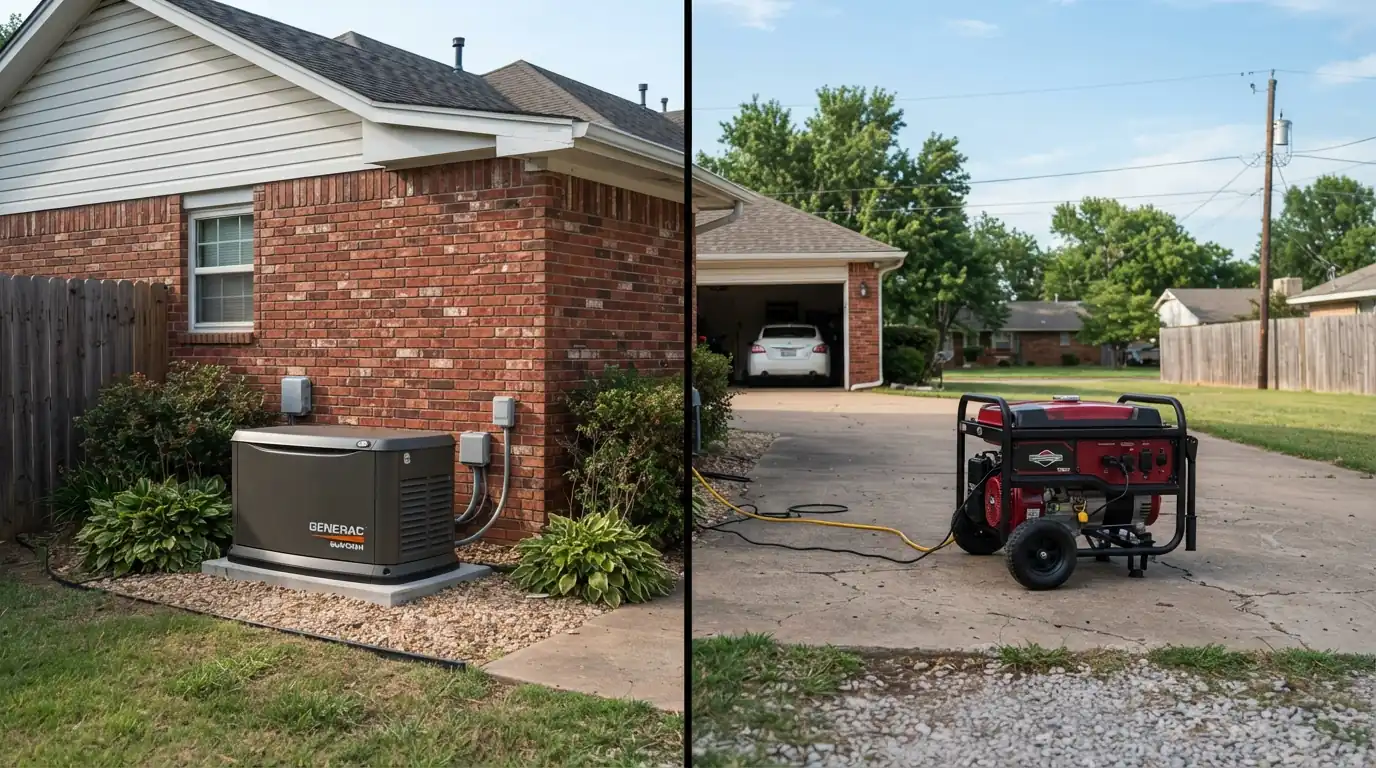
A standby generator is a permanent unit on a pad beside the house, wired through an automatic transfer switch and fed from the gas line. When the grid drops, it starts, waits a few seconds to reach speed, and takes over the house. When power returns, it switches back and shuts down. It exercises itself weekly and needs an annual service.
A portable generator lives in the garage until it is needed. With a proper hookup, an inlet box on the outside wall and an interlock or manual transfer switch at the panel, it can power chosen circuits safely. Without that hookup it is a set of extension cords to a few appliances.
Cost to buy and install
National 2026 guides put a whole-home standby generator at about $7,000 to $15,000 installed, with the unit itself about $4,000 to $8,000 and the transfer switch and electrical work about $1,500 to $3,500. Gas piping, a pad and permits make up the rest, and larger homes with central air usually need the larger units.
A portable setup costs the generator plus the hookup. A 2026 guide lists interlock kits at about $400 to $800, and transfer switch installation at about $1,200 to $1,600. Many homeowners already own a portable, which makes the hookup the only cost.
Runtime and fuel
On natural gas, a standby generator runs for as long as the outage lasts, which matters in an ice storm when restoration can take days. On propane it runs as long as the tank allows. There is nothing to refill in the middle of the night.
A portable runs on gasoline, and a tank typically lasts hours, not days. That means refueling trips, stored fuel and someone awake to manage it. For a short summer outage that is fine. For a week-long ice storm, it becomes a real chore, and fuel can be hard to find.
What they can carry
Standby units sized at about 18 to 26 kilowatts can run central air along with the rest of the house, and load management lets a smaller unit carry the whole panel by shedding big loads briefly. That makes a standby generator close to invisible during an outage.
Most portables carry the essentials: the furnace blower, the fridge and freezer, some lights, the network, maybe a window unit. Central air is usually out of reach. With an interlock you choose what runs by switching circuits on and off at the panel; with a transfer switch you choose from the circuits that were wired to it.
Not sure which suits your household?
Call and tell us what you need to run and for how long. We size both options and explain the trade-offs.
Convenience and safety
A standby generator is the only option that works when nobody is home, which matters for pets, sump pumps, freezers and anyone who travels. It also removes the most dangerous part of generator use: running an engine near the house. Portables must run outdoors, well away from windows and doors, never in a garage, because of carbon monoxide.
The single most dangerous thing people do with portables is backfeeding the house through a dryer outlet with a double-ended cord. It can energize the utility line and endanger line workers, and it can destroy the generator when power returns. A proper inlet and interlock or transfer switch is the safe way.
A middle path: an interlock and a portable
Between a cord-and-plug portable and an automatic standby unit sits a common compromise: a portable generator connected through an inlet box and a panel interlock. The interlock prevents the main breaker and the generator breaker from being on at the same time, so the generator can feed chosen house circuits without backfeeding the grid.
It is manual, someone has to roll out the generator and switch over, but it lets a portable run the furnace and hardwired circuits safely. National 2026 guides put an interlock kit installation at about $400 to $800.
Placement, noise and neighbors
A standby generator has manufacturer clearances from windows, doors, vents and the house wall, and local rules can add setbacks from property lines. Those clearances decide where the pad goes, which in turn affects the length of the gas line and the electrical run.
Noise varies by model and load. Standby units exercise briefly each week, usually at a time you choose. Portables are often louder and sit wherever the cord reaches, which is worth thinking about on a quiet street during a long outage.
Maintenance over the years
A standby generator runs a short self-test every week and needs an annual service: oil and filters, the battery, spark plugs and a check of the transfer switch. National 2026 guides put a maintenance visit at about $172 to $395.
Portables need attention too: stabilized fuel or an empty tank between uses, a monthly run under some load, and a fresh battery on electric-start models. The generator that was ignored all year is the one that will not start when the ice comes.
How to decide
Choose a standby generator if outages here have cost you before, if someone in the house depends on power for health reasons, if you travel, or if you want central air through a long outage. Choose a portable with a proper hookup if outages are occasional, you already own a generator, and someone will be home to run it. Many families start with a portable hookup and add a standby later; the transfer switch work is not wasted.
Related services
Where this guide leads
Standby Generator Installation
Generac and Kohler air-cooled units.
Standby Generator Installation detailsGenerator Transfer Switch Installation
Manual transfer switch.
Generator Transfer Switch Installation detailsHome Battery Backup Installation
Tesla Powerwall.
Home Battery Backup Installation detailsQuestions
Quick questions on this topic
A portable hookup is far cheaper to install. A standby costs more but runs on its own for as long as the outage lasts.
Usually not. Most portables carry essentials; central air needs a large standby unit.
An inlet with an interlock or transfer switch is the safe, permitted way to power house circuits.
On natural gas, as long as the outage lasts; on propane, as long as the tank allows.
Yes. Many homes start with a portable hookup and upgrade later.
Keep reading
More guides from the same desk
How to choose an electrician
Hiring an electrician in Oklahoma City?
Read the guideWhat a panel upgrade costs
How much does a 200 amp panel upgrade cost in Oklahoma City?
Read the guideAluminum wiring repair options
Aluminum wiring in a 1965 to 1973 Oklahoma City home?
Read the guide