Updated October 2026
By Sheldon Talbot, Electrical Guides Editor. Updated October 2026
Quick answer
In an Oklahoma City ice storm outage, report it to your utility, switch off or unplug sensitive electronics and large appliances, and leave one light switched on so you know when power returns. Run any portable generator outdoors, well away from doors and windows, and never backfeed the house through an outlet. If your mast, meter or service drop is damaged, the utility will not reconnect until an electrician repairs your side.
Why ice storms knock out power for days
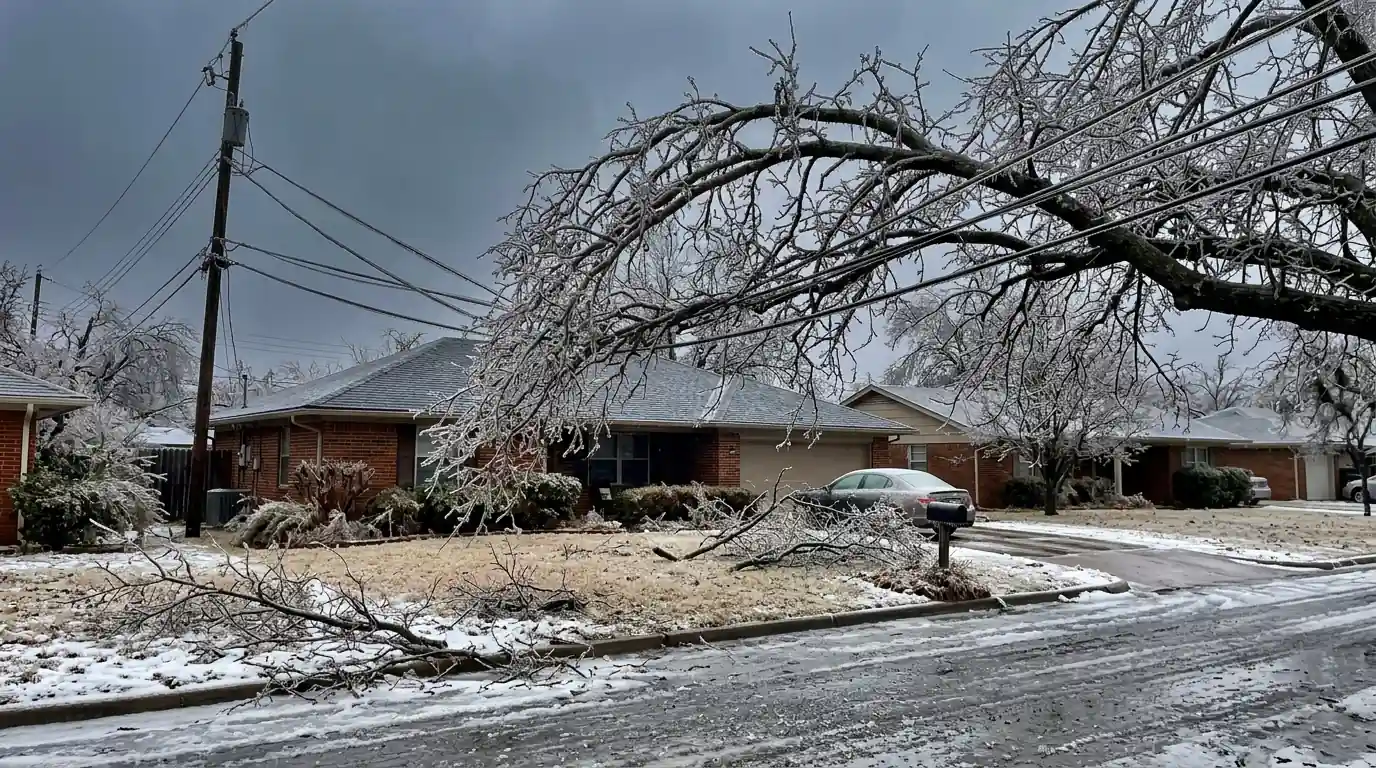
Ice is heavier than it looks. Freezing rain coats every limb and line, and trees that would shrug off wind start dropping branches onto the wires. The October 26 to 28, 2020 storm put at least an inch and a half of freezing rain on central Oklahoma, the first October ice storm warning the Norman weather office had ever issued, and left hundreds of thousands of people without power.
Repairs take time because the damage is everywhere at once. Eleven days after that storm began, the state still counted 54,490 outages, including 42,433 in Oklahoma City. Knowing that a long outage is possible changes what you do in the first hour.
The first hour: report, switch off, stay clear
Report the outage to your utility even if you think the neighbors already have. Then switch off or unplug computers, televisions and other electronics, and turn off large appliances such as the range, dryer and electric water heater at their breakers. Leave one ordinary light switched on so you can tell when power returns.
Stay well away from any downed or sagging line, and treat every wire on the ground as live. Ice-loaded limbs can keep falling for hours after the freezing rain stops, so keep children and pets out of the yard near lines and trees until crews have been through.
Is it the utility, or is it your house?
If the whole street is dark, the fault is on the utility's side and the fix is theirs. If your neighbors have power and you do not, or only part of your house works, the problem may be your service drop, the mast and meter on the side of the house, or the main breaker.
Look at the outside of the house from a safe distance. A mast bent or pulled away from the wall, a service drop hanging low or a meter base pulled loose means the house side needs an electrician. The utility can restore the line to the pole, but it will not reconnect a damaged house until the repair is made and, where required, inspected.
Service mast down after the ice?
Call any hour. We repair the house side so the utility can reconnect.
Running a generator safely
A portable generator belongs outdoors, well away from doors, windows and vents, never in a garage or on a porch, because its exhaust carries carbon monoxide. Battery-backed carbon monoxide alarms inside the house are worth having before the storm, not after.
Never plug a generator into a wall outlet to power the house. Backfeeding sends power out through your service to the lines, where it can injure a lineworker, and it can destroy the generator when the grid returns. Use heavy extension cords to individual appliances, or have an interlock or transfer switch installed so the generator can feed chosen circuits safely.
Keeping heat and water going
Most gas furnaces still need electricity for the blower and controls, so a gas house can be cold in an outage too. A generator connected through a transfer switch or interlock can run the furnace; an extension cord cannot. Space heaters on a generator should be plugged in directly, never on a shared cord with other loads.
Homes on wells lose water when the pump loses power. If your property depends on a well, plan generator capacity for the pump's starting load, and keep stored water for the first day. Open cabinet doors under sinks on outside walls to keep pipes from freezing while the heat is off.
When the power comes back
Restoration can bring brief surges and dips while the utility switches circuits back on. Wait a few minutes before turning large appliances back on, then bring them back one at a time rather than all at once, so the house does not start every motor together.
Pay attention for the first hour. Lights that flicker or run brighter than normal, a burning smell, warm outlets or a breaker that trips repeatedly all mean something is wrong, often a damaged neutral at the service. Switch off the main and call an electrician if you notice any of them; do not keep resetting breakers.
After the storm: what to check and photograph
Once it is safe to be outside, walk around the house and look at the service mast, the weatherhead, the drip loop and the meter base. Photograph anything bent, pulled or scorched for the insurance claim before repairs begin, and note any limbs still resting on the service drop.
Inside, check the panel for signs of water, look for breakers that will not stay on, and test GFCI outlets. If the storm exposed weak spots, such as no surge protection or no safe way to connect a generator, that is the time to plan a whole-home surge protector or a transfer switch before the next one.
Related services
Where this guide leads
Storm Damage Electrical Repair
Downed service drop.
Storm Damage Electrical Repair detailsService Mast & Meter Base Repair
Bent or pulled mast.
Service Mast & Meter Base Repair detailsGenerator Transfer Switch Installation
Manual transfer switch.
Generator Transfer Switch Installation detailsQuestions
Quick questions on this topic
You can, or switch off large appliances and electronics; either protects them when power returns.
The utility owns the drop to the house; the mast, meter base and wiring on the house are the homeowner's to repair.
Only through a transfer switch or interlock, not an extension cord.
It can be a damaged neutral or loose service connection. Switch off the main and call an electrician.
Well away from doors, windows and vents, and never inside a garage or enclosed porch.
Keep reading
More guides from the same desk
Smoke and CO alarm placement
Where should smoke and CO alarms go in an Oklahoma City home, how often should you replace them, and is hardwired worth it?
Read the guideWhat a panel upgrade costs
How much does a 200 amp panel upgrade cost in Oklahoma City?
Read the guideStandby vs portable generator
Choosing backup power in Oklahoma City?
Read the guide