Updated October 2026
By Sheldon Talbot, Electrical Guides Editor. Updated October 2026
Quick answer
To size a generator for an Oklahoma City house, list the appliances and circuits you need during an outage, add up their running watts, then allow for the largest motor's starting surge, usually the air conditioner, well pump or refrigerator. Essentials only can often run on a large portable or small standby unit; running central air and most of the house usually calls for a home standby generator sized from a load calculation.
Start with what has to keep running
Generator size is a choice about comfort and cost, not a property of the house. A small home that wants central air running needs more generator than a large home that only wants the refrigerator, furnace blower, lights and internet. So the first step is a list: what must keep running in a summer storm, and what must keep running in a winter ice storm.
For most Oklahoma City households the list includes the refrigerator and freezer, the furnace blower or a few heaters, some lights and outlets, the internet and phone chargers, and, for many, the air conditioner. Homes on wells add the pump. Medical equipment goes at the top of the list if anyone depends on it.
Running watts and starting watts
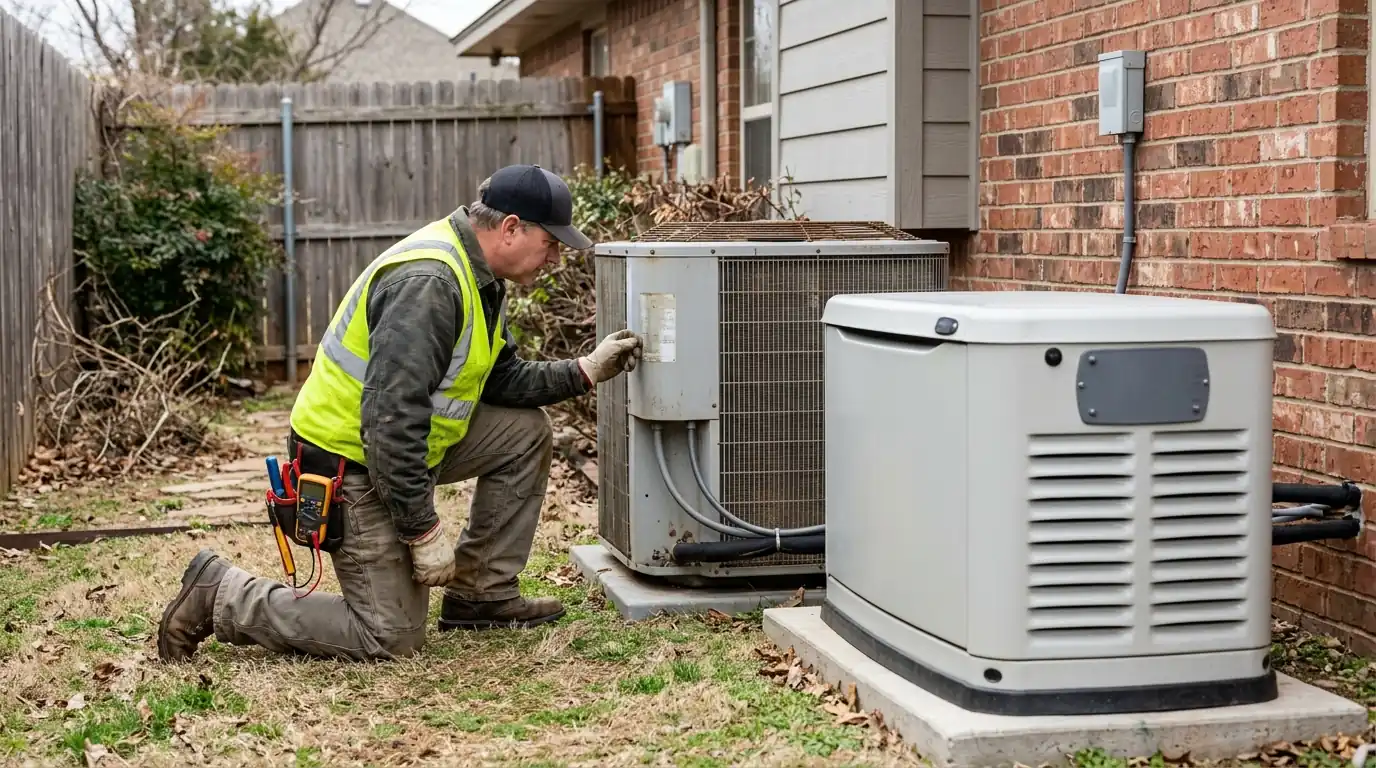
Every appliance has running watts, the power it draws once it is going, and motors also have starting watts, a short surge when they start that can be two to three times the running figure or more. A refrigerator might run on a few hundred watts but need much more for the second its compressor starts.
A generator has to cover the total running load plus the biggest starting surge it will see at one time. That is why the largest motor in the house usually decides the size. Nameplates on the appliances, or the manuals, give the real figures; estimates from charts are only a starting point.
An essentials list and what it usually adds up to
A typical essentials list, refrigerator, freezer, furnace blower, a few lights, the internet, a microwave used occasionally and phone chargers, often lands within the range of a large portable generator, provided the loads are not all started at once. Add a well pump and the starting surge grows quickly.
Electric ranges, dryers and electric water heaters are the loads that make small generators impractical, because each draws thousands of watts. Most essentials plans leave them off and use the gas appliances or a slow cooker instead. A transfer switch or interlock lets you choose which circuits the generator feeds.
Want the generator sized from real numbers?
Call to set up a load calculation. We size it to what you want running.
Whole-house backup and the air conditioner
Running central air is the line between an essentials generator and a whole-home one. A central air compressor has a large starting surge, so a generator that comfortably runs the running load can still stall when the compressor kicks on. In Oklahoma City summers, when storms often arrive on hot afternoons, that is the load many people care about most.
Soft-start kits on the air conditioner reduce that surge and can let a smaller standby generator run it. Load management modules on standby generators can also hold off the air conditioner or the water heater until there is capacity. Both are cheaper than buying a larger generator, and both are part of a good sizing plan.
Portable or standby: what the size means for each
Portable generators are limited by how much an engine on wheels can produce and how long it can run between refuelings. They suit essentials plans, connected through an interlock or transfer switch so the house circuits are fed safely.
Home standby generators sit on a pad, start automatically, and commonly run from about 10 to 26 kilowatts for air-cooled residential units. They are sized from a load calculation and paired with an automatic transfer switch. National 2026 planning figures put a whole-home standby generator at about $7,000 to $15,000 installed, which includes the unit, the transfer switch and the electrical work.
Fuel and how long it runs
Fuel changes both the size and the runtime. Many standby generators produce somewhat less power on natural gas than on propane, so the rating you plan around should be the one for your fuel. Natural gas runs as long as the supply holds; propane runs as long as the tank lasts; gasoline in a portable needs refilling every several hours.
In an ice storm that keeps the grid down for days, fuel planning matters as much as watts. A generator that is sized well but runs out of fuel on the second night has not solved the problem.
Getting it sized properly
The most reliable way to size a generator is a load calculation built from your panel, your appliance nameplates and the list of loads you chose, sometimes checked against a year of utility bills. It turns guesswork into a number, and it shows whether a soft starter or load management can bring that number down.
Ask anyone quoting a generator how they sized it. If the answer is the square footage of the house, ask for the load calculation instead. The right size is the one that starts your largest motor without stalling, carries what you chose, and does it on the fuel you have.
Related services
Where this guide leads
Standby Generator Installation
Generac and Kohler air-cooled units.
Standby Generator Installation detailsGenerator Transfer Switch Installation
Manual transfer switch.
Generator Transfer Switch Installation detailsHome Battery Backup Installation
Tesla Powerwall.
Home Battery Backup Installation detailsQuestions
Quick questions on this topic
Often, yes. It cuts the compressor's starting surge so a smaller standby unit can carry it.
Usually a mid-size portable can, as long as the starting surges are not all at once. Check the nameplates.
No. The loads you want to run and their starting watts decide it.
To power house circuits safely, yes, a transfer switch or a panel interlock.
Many do produce somewhat less on natural gas than on propane; size from the rating for your fuel.
Keep reading
More guides from the same desk
Standby vs portable generator
Choosing backup power in Oklahoma City?
Read the guideWhat a panel upgrade costs
How much does a 200 amp panel upgrade cost in Oklahoma City?
Read the guideSigns your house needs rewiring
Warm outlets, two-prong plugs, cloth wiring or constant trips in an older Oklahoma City home?
Read the guide